Do You Actually Need a Unified Commerce Platform, or Is Shopify POS Enough?

By Robin Laseur

If your online store and your physical retail already run on Shopify, you probably have a unified commerce platform and do not know it. Shopify POS and your online store are built on the same system, which means one stock count, one customer record, and one order view across both, without a separate integration to hold them together. So the honest version of the question is narrower than the way it is usually asked. It is not “do I need unified commerce,” it is “have I hit the specific point where native Shopify stops being enough and a dedicated platform or heavy custom work becomes justified.” This guide maps that boundary so you can tell which side of it you are on.
The assumption worth checking before you shop for a platform
Most advice on this question quietly assumes you are starting from disconnected systems. That assumption is often wrong for a Shopify merchant, and it is the reason the answer gets muddled.
The distinction that matters is between systems that are synced and systems that are unified. Synced systems are separate and exchange data on a schedule, so they disagree between updates. Unified systems share one record, so there is nothing to reconcile. Because Shopify POS and the Shopify online store sit on the same platform, they are unified by default rather than synced. Shopify’s own point-of-sale documentation describes inventory that is tracked and assigned per location and syncs in real time across POS, the online store, and every sales channel. That is the technical definition of unified commerce for the store-plus-online case, already running, with no middleware in between.
This is why the enterprise-partner framing that pushes every growing brand toward a dedicated unified commerce platform is misleading for a large share of Shopify merchants. They are being sold the fix for a problem the platform already solved. The useful question is not whether to acquire unified commerce, it is whether your operation has grown past what the native version covers. For most store-plus-online brands, it has not yet, and the burden of proof should sit with the platform pitch, not with staying where you are.
What native Shopify already covers
Before deciding native is not enough, it is worth being precise about what native includes, because the list is longer than most merchants assume. The full mechanics, tiers, and cost sit in our Shopify POS explainer; the summary that matters for this decision is below.
POS Lite comes with every Shopify plan and handles in-store checkout with real-time inventory sync between the online store and its assigned location. POS Pro, a paid per-location add-on that is included with Shopify Plus, adds the operational layer that multi-location retail needs: staff roles and permissions, full multi-location inventory management, demand forecasting, cross-location transfers and receiving, and detailed reporting by location, product, and staff.
On the customer-facing side, native Shopify already runs the omnichannel workflows that used to define a “unified commerce platform.” According to Shopify’s point-of-sale features, staff can sell in store and ship to the customer from any location that holds stock, accept returns and exchanges across online and other stores with inventory updating instantly, fulfil buy-online-pickup-in-store and local delivery orders from the POS, and look up stock at other locations to save a sale when an item is not on the shelf. Inventory transfers, supplier purchase orders, and on-the-spot stock counts run natively inside the same admin. In practical terms, a store-plus-online Shopify brand can turn each location into a fulfilment node without buying anything beyond POS Pro.
That is a real unified commerce operation. If your complexity fits inside those capabilities, a separate platform does not remove friction you have, it adds cost and a migration you do not need.
The comparison that actually decides it
A dedicated unified commerce platform, or a heavy custom integration layer, earns its place only where native capability runs out. Framed as a comparison, the boundary looks like this.
Requirement | Native Shopify (POS Lite / Pro) handles it | Points past native toward a platform or custom integration |
Online and in-store on one stock count | Yes, by default on one platform | Not a reason to leave native |
Multiple locations | Yes, scales to hundreds of locations on Plus | Not location count alone, but complex allocation across many nodes |
BOPIS, ship-from-store, endless aisle, cross-channel returns | Yes, native in POS Pro | Not a reason to leave native |
Fulfilment routing | Yes, closest-location and priority-order routing | Sophisticated multi-node sourcing, drop-ship networks, complex 3PL orchestration |
Back-office finance and procurement | Connects to your ERP; consolidates sales data | ERP required as the inventory master, or deep manufacturing and procurement logic |
B2B and wholesale | Native B2B on Plus, in-person B2B added in Winter ’26 | Complex per-account catalogs, credit terms, EDI or punchout |
Clienteling and loyalty | Customer profiles, purchase history, loyalty insights in POS | Deep clienteling, appointment or styling workflows, advanced loyalty tiers |
Read down the right column. None of those are “you have stores” or “you have several locations.” They are specific structural conditions. If none of them describe you, the comparison is already settled in native’s favour.

The four conditions where native stops being enough
The boundary is not a revenue number or a store count. It is the appearance of one of four structural conditions, each of which points past what native was built to do.
The inventory master needs to live outside Shopify
Native unified commerce works because Shopify holds the authoritative stock number. If your operation requires an ERP or a dedicated order management system to be the source of truth, because finance, procurement, or manufacturing depends on it, then Shopify becomes one node in a larger architecture rather than the centre of it. That is an integration decision, and where the ERP must own inventory, the ERP integration work is where the real complexity and cost sit, not in the POS.
Fulfilment sourcing exceeds native routing
Shopify routes orders to the closest location with stock, or by a priority order you set. That covers most store-and-warehouse operations. It stops being enough when you need genuinely sophisticated distributed order management: multi-node allocation optimisation, complex drop-ship networks, or 3PL orchestration with rules native routing cannot express. At that point a dedicated OMS layer, connected to Shopify, does work native cannot.
B2B or wholesale complexity outgrows the native modules
Shopify’s native B2B, on Plus, handles company accounts, catalogs, and price lists, and Winter ’26 added in-person B2B on POS. That is enough for many brands running wholesale alongside retail. It reaches its limit with complex per-account catalog rules, layered credit and approval terms, or trading-partner requirements like EDI and punchout, which push toward custom integration or a dedicated system.
Clienteling or loyalty depth exceeds POS Pro
POS Pro carries customer profiles, purchase history, and loyalty insights at the register, which supports ordinary clienteling. Brands that need deep styling and appointment workflows, sophisticated loyalty tiers, or a specialist clienteling tool will add that layer on top of Shopify rather than find it native.
Notice what is absent from this list. Scale, on its own, is not a trigger. Shopify Plus supports up to 200 locations by default and more on request, so a brand can grow to a large retail footprint without outgrowing native, provided the four conditions above stay simple. The trigger is structural complexity, not size.
What “you need a platform” usually really means
When a Shopify brand does cross one of those boundaries, the answer is rarely “replace everything with a dedicated unified commerce platform.” That is the most expensive reading of the situation and usually the wrong one.
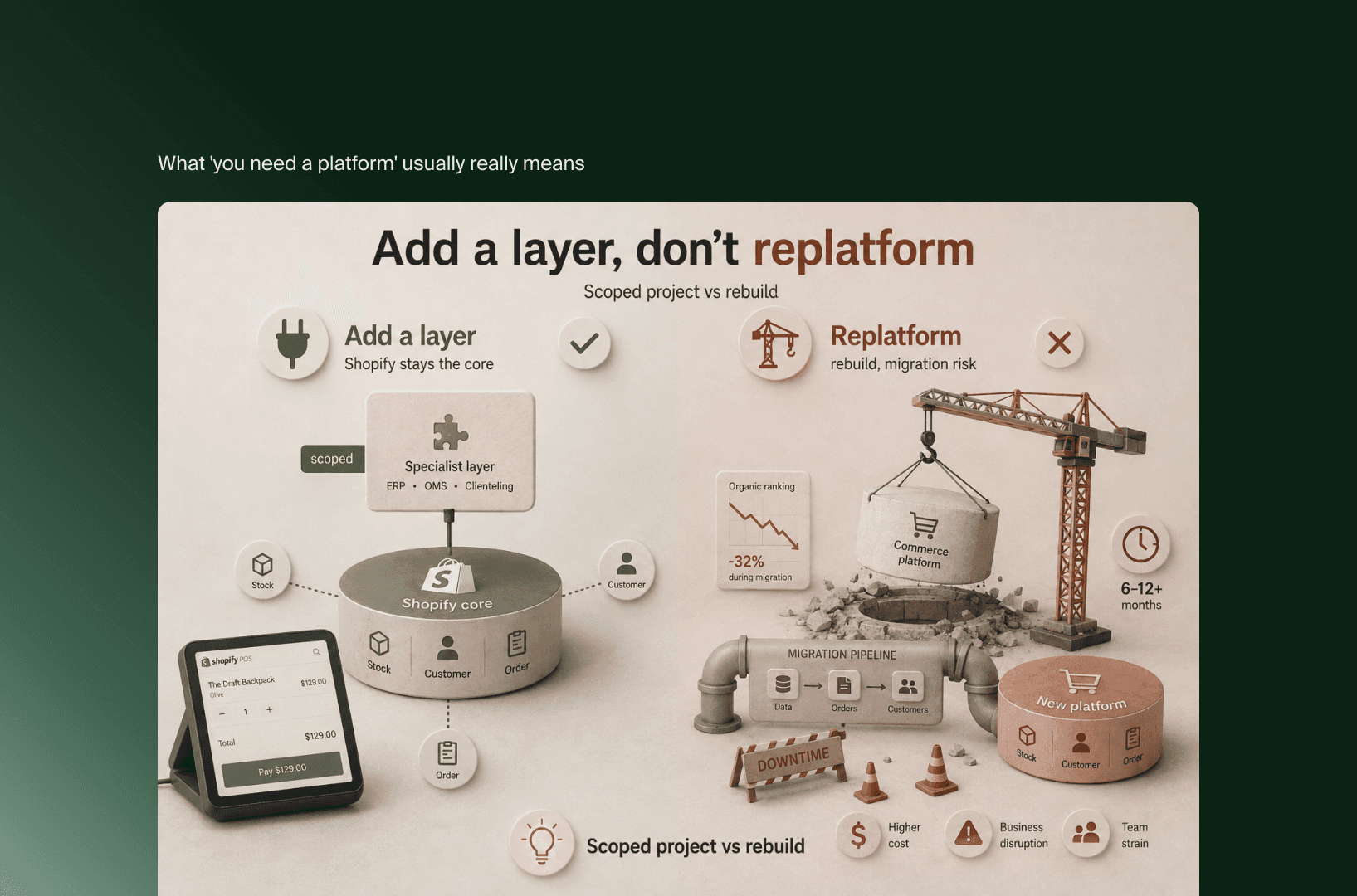
In practice, crossing a boundary means adding a layer, not tearing out the foundation. An ERP integration so finance can own the numbers it needs. A dedicated OMS connected to Shopify for complex fulfilment. A clienteling app for the store team. Shopify stays the commerce and retail core, and the specialist system handles the specialist job. A full replatform onto a different unified commerce suite is the rare case, justified only when Shopify genuinely cannot hold the commerce layer for your model, which is uncommon for a store-plus-online brand.
This matters commercially because the two paths cost very different amounts. Adding an integration is a scoped project. Replatforming is a rebuild with migration risk, ranking exposure, and months of disruption. Treating every boundary as a reason to replatform is how brands spend rebuild money on a problem an integration would have solved.
Placing yourself: enough, integrate, or outgrown
You can reach a defensible answer by checking your operation against the four conditions.
You are already enough if your online store and stores run on Shopify, your fulfilment fits closest-location or priority routing, your B2B and clienteling needs sit inside the native modules, and no external system needs to own your inventory. You have unified commerce. A dedicated platform would add cost without removing friction, and the right move is to use POS Pro fully rather than shop for a replacement.
You need to integrate, not replatform if one or two boundary conditions are true: an ERP that must be the inventory master, fulfilment logic beyond native routing, or B2B and clienteling depth past the native modules. The work is a connected layer on top of Shopify, scoped to the specific gap, not a new platform.
You may have genuinely outgrown native only if several of these conditions stack up at once and Shopify can no longer serve as the commerce core, which is the exception rather than the rule. That case deserves a real evaluation before any decision, because it is the one with the highest cost of getting wrong.
If you are near a boundary and cannot tell whether you need an integration or a bigger move, that judgement is worth pressure-testing against your actual fulfilment and back-office setup. As a Shopify Platinum Partner that builds both native retail setups and the integration layers around them, Flatline can help you locate the boundary for your specific stack, with no obligation to build anything.
Key takeaways
If your store and online already run on Shopify, you already have unified commerce on one source of truth. The question is not whether to acquire it, but whether you have outgrown the native version.
Native Shopify, with POS Pro, covers real-time cross-channel inventory, BOPIS, ship-from-store, endless aisle, cross-channel returns, transfers, and multi-location management up to a large scale.
Native stops being enough only on four structural conditions: an external system must own inventory, fulfilment sourcing exceeds native routing, B2B or wholesale complexity outgrows the native modules, or clienteling and loyalty depth exceed POS Pro.
Scale alone is not a trigger. Shopify scales to hundreds of locations, so the boundary is structural complexity, not store count.
Crossing a boundary usually means adding an integration layer, not replatforming. Treating every boundary as a reason to replace the platform is how brands overspend.
FAQ
Is Shopify POS enough for multiple retail locations?
For most multi-location retailers, yes. Shopify POS Pro provides real-time inventory across locations, cross-location transfers, ship-from-store, BOPIS, and per-location reporting, and Shopify Plus scales to hundreds of locations. The exception is not location count itself but complex fulfilment allocation or an external system that must own inventory.
When do I actually need a dedicated unified commerce platform or OMS?
When a structural condition appears that native cannot express: an ERP or OMS that must be the inventory master, sophisticated multi-node fulfilment sourcing, complex B2B requirements like EDI or per-account catalogs, or deep clienteling. Even then, the usual answer is a system connected to Shopify, not a full replatform.
What is the difference between native Shopify and a dedicated unified commerce platform?
Native Shopify unifies your online store and physical retail on one platform, so inventory, customers, and orders share a single record without integration. A dedicated platform is warranted only where your fulfilment, back-office, or B2B complexity exceeds what native handles, and in most cases it sits alongside Shopify to fill a specific gap rather than replacing it.
Related articles


F.A.Q.

Is Shopify POS enough for multiple retail locations?
For most multi-location retailers, yes. Shopify POS Pro provides real-time inventory across locations, cross-location transfers, ship-from-store, BOPIS, and per-location reporting, and Shopify Plus scales to hundreds of locations. The exception is not location count itself but complex fulfilment allocation or an external system that must own inventory.
When do I actually need a dedicated unified commerce platform or OMS?
When a structural condition appears that native cannot express: an ERP or OMS that must be the inventory master, sophisticated multi-node fulfilment sourcing, complex B2B requirements like EDI or per-account catalogs, or deep clienteling. Even then, the usual answer is a system connected to Shopify, not a full replatform.
What is the difference between native Shopify and a dedicated unified commerce platform?
Native Shopify unifies your online store and physical retail on one platform, so inventory, customers, and orders share a single record without integration. A dedicated platform is warranted only where your fulfilment, back-office, or B2B complexity exceeds what native handles, and in most cases it sits alongside Shopify to fill a specific gap rather than replacing it.