Are You Growing, or Just Buying Revenue? A Profitability Gut-Check for DTC Founders

By Robin Laseur

Revenue is the one number in your business you can always buy more of. That is why a rising revenue chart proves less than it feels like it proves. Growth that compounds value and growth that is rented from your ad account look identical on that chart, right up until the moment the spending has to stop. The difference between the two is not visible on the top line. It sits in your margin, your new-customer acquisition cost, and your repeat rate, and you can check it in about ten minutes. This gut-check tells you which kind of growth you have. It is built to give you a clean “you’re fine, keep going” as readily as a warning, because both answers are worth knowing.
Why a rising revenue chart proves nothing
Most other business metrics resist being bought. You cannot easily buy a higher repeat rate or a fatter margin; you have to earn them. Revenue is different, because you can always spend more on acquisition and get more sales in return, regardless of whether those sales make money. That makes revenue the metric most likely to look healthy while the business underneath it weakens.
So the top-line chart cannot answer the question founders actually care about, which is whether the growth is durable. A brand compounding value and a brand buying revenue can post the same curve for a year or more. The tell is not how fast revenue is rising, it is what each new dollar of it costs and how much of it comes back. The checks below look at exactly that.
How to use this gut-check
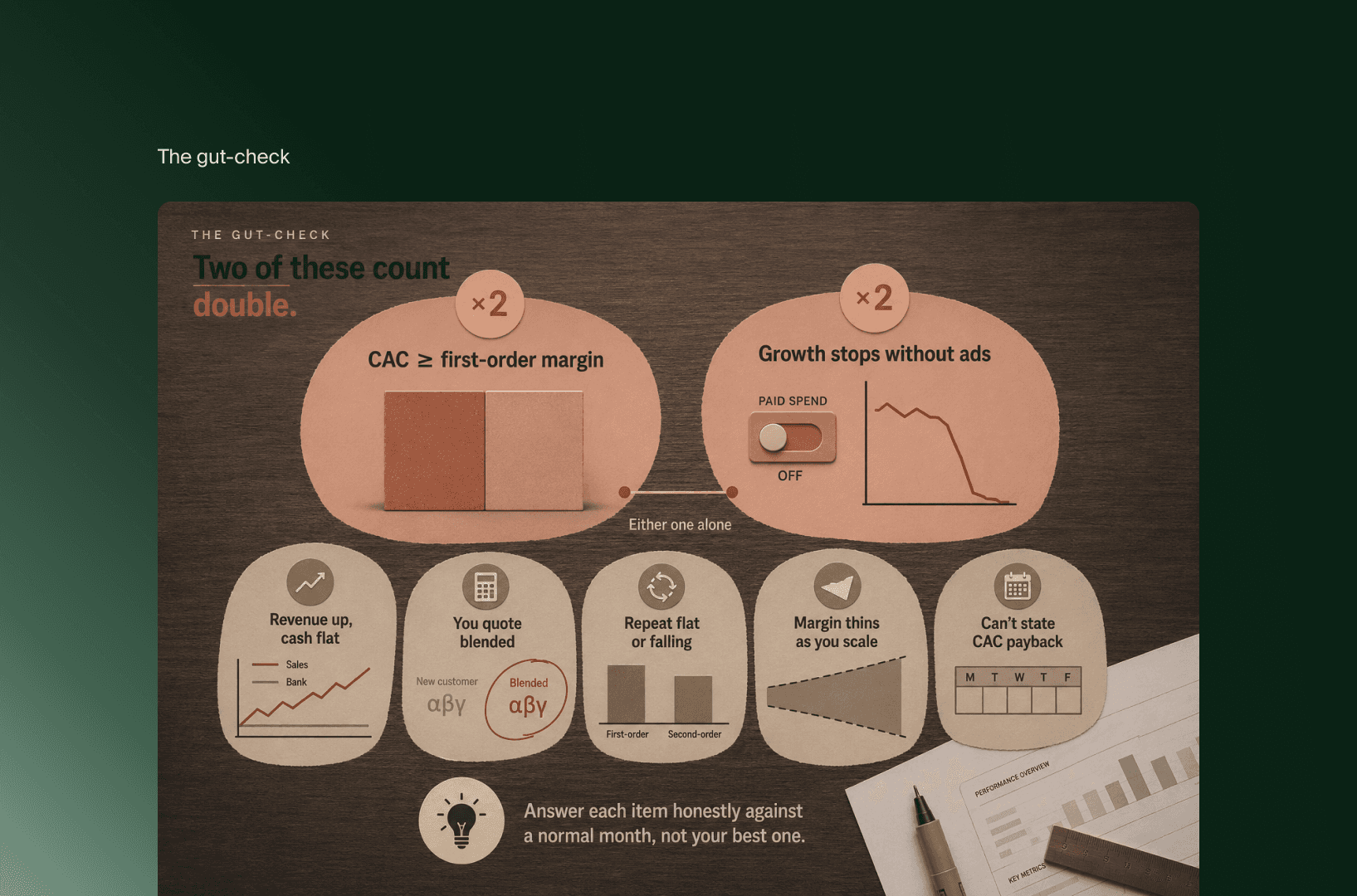
Answer each item honestly against a normal month, not your best one. A single strong month proves as little as a single rising chart.
Two of the checks carry more weight, because they are the ones that most directly separate rented growth from earned growth. They are marked, and count double when you score.
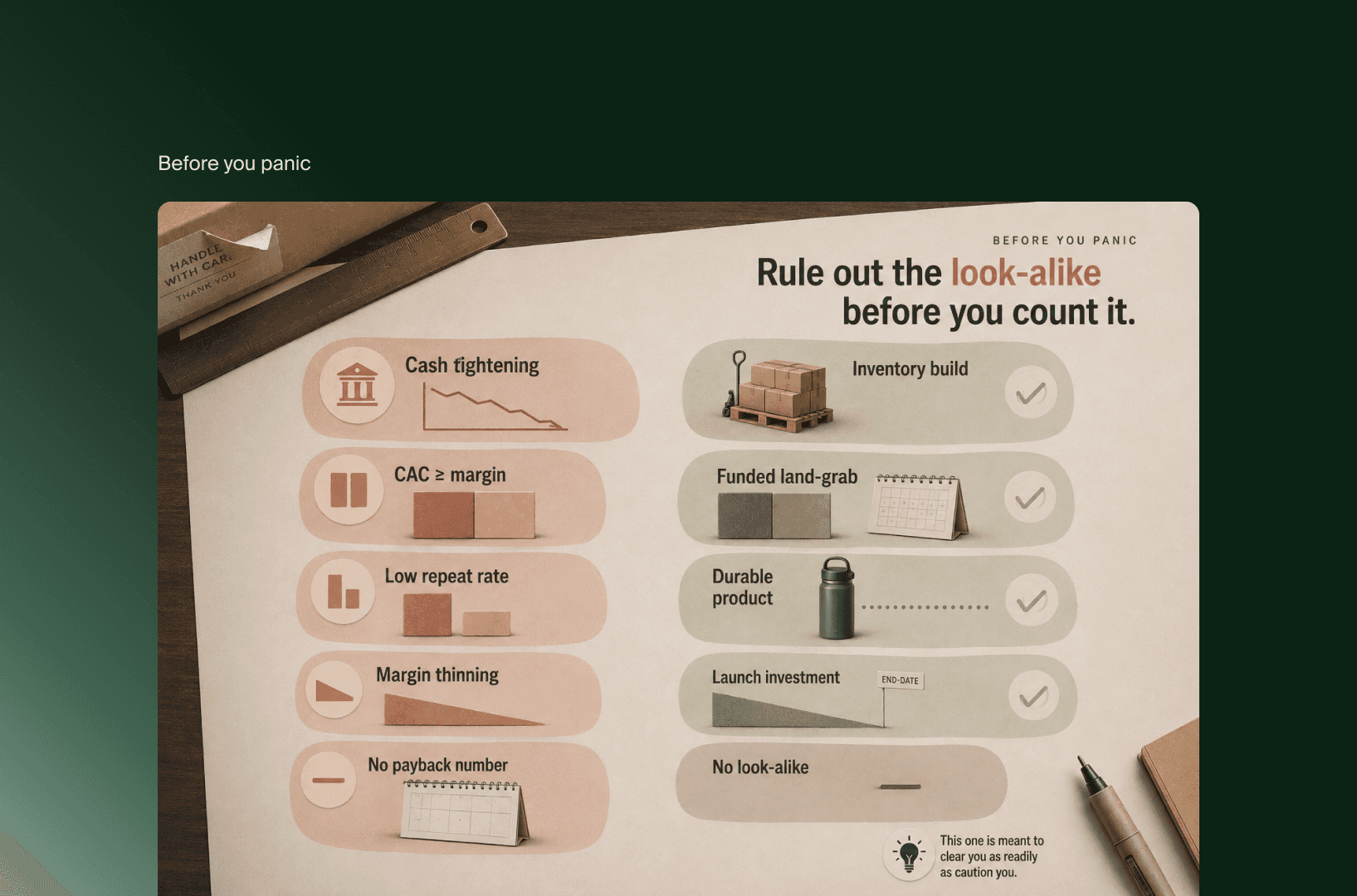
Each check also has a look-alike: a reason the symptom might be present without meaning your growth is unprofitable. Rule the look-alike out before you count the check, because the point of this exercise is an honest verdict, not a scare.
The gut-check
1. Revenue is up, but cash is flat or tighter
Growing sales should, eventually, mean more money in the bank. If revenue is climbing while your cash position stays flat or shrinks, growth may be consuming more than it returns. The look-alike: a deliberate inventory build or a one-off capital expense can tighten cash in a healthy business. The tell is whether the cash is going into assets you chose to buy, or quietly disappearing into the cost of each sale.
2. New-customer CAC is at or above your first-order contribution margin (weighted)
This is the core test. Take what it costs to acquire a genuinely new customer, counting only net-new buyers, and compare it to the contribution margin a first order leaves after all variable costs. If acquisition costs as much as or more than the first order earns, every new customer loses money at the point of sale, and you are relying on future orders to rescue it. The look-alike: a funded, deliberate land-grab where you know your lifetime value supports the payback. The tell is simple, and it is the next check.
3. The acquisition number you quote to feel okay is a blended one
When you reassure yourself that acquisition is fine, notice which number you reach for. A blended CAC or blended ROAS folds in returning customers you did not pay to acquire, so it flatters the paid, net-new economics that actually decide sustainability. The look-alike: you already track new-customer CAC specifically and it is healthy, in which case the blended figure is just context and not a comfort blanket.
4. Repeat rate is flat or falling as you scale
If your growth is coming almost entirely from new customers while the share who come back stays flat or drops, you are replacing customers rather than accumulating them, which is the acquisition treadmill running at full speed to stand still. The look-alike: a genuinely one-time or durable product, where a low repeat rate is structural rather than a failure. Judge repeat rate against your own category, not a universal number.
5. Contribution margin thins as revenue grows
Healthy scale usually holds or improves margin. If bigger revenue is arriving with a thinner contribution margin, growth is being bought, whether through discounts, rising acquisition costs, or a channel mix tilting toward expensive paid. The look-alike: a deliberate, temporary margin investment in a launch or a new market, with a date on which it ends.
6. Growth stops the moment you cut ad spend (weighted)
Picture pausing paid for a month. If the honest expectation is that sales fall off a cliff, your growth is fully rented, with no organic or retention base underneath it. A durable business keeps selling, at a lower level, when the ads go quiet. The look-alike: a genuinely early-stage brand where paid is expected to carry most of demand for now, as long as the plan is to build the base rather than rent forever.
7. You cannot state your CAC payback period
If you do not know how many months it takes to recover the cost of acquiring a customer, you are missing the one number that tells you whether acquisition is sustainable. The look-alike: there isn’t really one. This is a measurement gap to close regardless of the rest, because every other check gets sharper once you can answer it.
What your answers mean
Score one point per check, with checks 2 and 6 counting double.
0 to 1 points. Your growth is most likely compounding value. The fundamentals that make revenue durable, margin, new-customer economics, and repeat behaviour, appear to be holding as you scale. Keep going, and keep watching the two weighted checks as you push spend.
2 to 3 points. Mixed signals. There is something worth looking at, but it may be explained by the look-alikes rather than by unprofitable growth. Work through each check you counted and confirm it is real before you act on it.
4 or more points, or both weighted checks. Your growth may be buying revenue rather than building value. The pattern suggests the top-line chart is outrunning the economics underneath it, and scaling spend further would widen the gap rather than close it.
Before you panic
The reason each check has a look-alike is that “we are buying unprofitable growth” is an easy conclusion to jump to and an expensive one to act on wrongly. A funded land-grab with a known payback is a strategy, not a leak. A low repeat rate on a genuinely durable product is physics, not failure. Tightening cash from an inventory build is a choice, not a symptom.
So if most of your checks turn out to be look-alikes on closer inspection, that is a real and useful result: your growth is healthier than it felt, and the honest move is to keep going with confidence. A gut-check that can only ever confirm your fears is not a diagnostic, it is anxiety with a checklist. This one is meant to clear you as readily as caution you.
If the gut-check says you’re buying revenue
If the checks hold up after you have ruled out the look-alikes, you have learned something worth knowing early rather than late: the growth is real revenue but not yet real value, and more spend will not fix that. Naming it is the first step, and it is genuinely most of the battle, because the founders who get into trouble are usually the ones who never ran the check.
The second step is a different question, which is which lever actually turns rented growth into earned growth, whether that is acquisition efficiency, conversion, or retention, and that depends on where your particular economics are constrained. That is the question to take up next, once the gut-check has told you there is a question to answer at all.
Key takeaways
Revenue is the one metric you can always buy more of, so a rising revenue chart cannot tell you whether growth is profitable. Margin, new-customer CAC, and repeat rate can.
The two sharpest tests are whether new-customer CAC is at or above first-order contribution margin, and whether growth would collapse if you paused ad spend. Either one, on its own, is a strong signal of rented growth.
Every check has a look-alike, so rule out funded land-grabs, durable-product economics, and deliberate margin or inventory choices before concluding your growth is unprofitable.
If you cannot state your CAC payback period, close that gap first, because every other check sharpens once you can.
The gut-check is meant to clear you as readily as warn you. A clean result means keep going; a warning means the next question is which lever fixes it, not how much more to spend.
FAQ
How do I know if my DTC growth is actually profitable?
Look past revenue to three numbers: your contribution margin, your new-customer CAC counting only net-new buyers, and your repeat rate against your own category. If new-customer CAC is at or above first-order contribution margin, if margin thins as you scale, and if growth would stop when ad spend does, the growth is likely being bought rather than earned. If those hold up, it is probably compounding value.
Is rising revenue a sign of a healthy business?
Not on its own. Revenue can be increased simply by spending more on acquisition, whether or not those sales are profitable, so a rising revenue chart looks identical for a compounding business and a rented one. Durability shows up in unit economics and repeat behaviour, not in the top-line trend.
What is CAC payback and why does it matter?
CAC payback is how many months of a customer’s contribution it takes to recover the cost of acquiring them. It matters because it tells you whether your acquisition spending is sustainable: a short payback means you recoup and reinvest quickly, while a long or unknown payback means you may be funding growth you cannot sustain. Not knowing it is itself a warning sign.
Related articles


F.A.Q.

How do I know if my DTC growth is actually profitable?
Look past revenue to three numbers: your contribution margin, your new-customer CAC counting only net-new buyers, and your repeat rate against your own category. If new-customer CAC is at or above first-order contribution margin, if margin thins as you scale, and if growth would stop when ad spend does, the growth is likely being bought rather than earned. If those hold up, it is probably compounding value.
Is rising revenue a sign of a healthy business?
Not on its own. Revenue can be increased simply by spending more on acquisition, whether or not those sales are profitable, so a rising revenue chart looks identical for a compounding business and a rented one. Durability shows up in unit economics and repeat behaviour, not in the top-line trend.
What is CAC payback and why does it matter?
CAC payback is how many months of a customer’s contribution it takes to recover the cost of acquiring them. It matters because it tells you whether your acquisition spending is sustainable: a short payback means you recoup and reinvest quickly, while a long or unknown payback means you may be funding growth you cannot sustain. Not knowing it is itself a warning sign.