Choosing a DTC Growth Partner: What to Evaluate for CRO, Retention and Measurement

By Robin Laseur

The word “growth” on an agency’s homepage tells you almost nothing, because a media buyer who reports blended ROAS and a partner who improves profitable growth both use it. That is the distinction that actually matters when you hire, and it is the one most evaluation processes miss. A genuine growth partner works the whole system, conversion, retention, and the measurement underneath both, and is accountable for profit rather than for a good-looking ROAS on a single campaign. A channel-tactics vendor buys media and hands you revenue that may or may not make money. This guide gives you the criteria that separate the two, the questions that expose the wrong one on a call, and a scorecard you can take into your shortlist.
Why “growth agency” is the wrong filter
The label is used loosely, and everyone who runs ads claims it. So filtering on the word, or on a channel list, sorts nobody. The useful filter is what the partner is accountable for. A vendor is accountable for channel performance: impressions, clicks, a reported return on ad spend. A growth partner is accountable for whether your growth is profitable and durable, which means they care about the same numbers you should, contribution margin, new-customer acquisition cost, repeat rate, and payback, not just the top line their channel produced.
That difference shows up in the first conversation. Ask a vendor about a stalled quarter and the answer is more spend, new creative, another channel. Ask a growth partner and they ask about your unit economics and where your growth is actually constrained before recommending anything. Every criterion below is a way to make that difference visible, and each is fair enough to help you judge any partner, including one you choose over us.
The criteria that actually matter
1. They measure profitable growth, not media performance
This is the gate. A partner who leads with blended ROAS and revenue is measuring the wrong thing, because both can rise while the business gets weaker. A growth partner speaks in contribution margin, new-customer CAC, and payback, and reports whether the growth they drove actually made money.
Ask them: how do you measure whether the growth you drive is profitable, and which numbers do you put in the report? A weak answer sounds like: blended ROAS and revenue, with no ability to speak to contribution margin or the cost of a genuinely new customer.
2. They work the whole system, not one channel
Profitable growth is a system, acquisition, conversion, and retention, bounded by margin, and its bottleneck is often not the channel a vendor sells. A partner who only buys media cannot fix a conversion leak or a retention gap, so they will keep spending against a constraint that spending does not move.
Ask them: if my binding constraint turns out to be conversion or retention rather than acquisition, how does your engagement change? A weak answer sounds like: every problem resolving to more budget or more creative, because acquisition is the only lever they hold.
3. CRO depth: they diagnose before they test
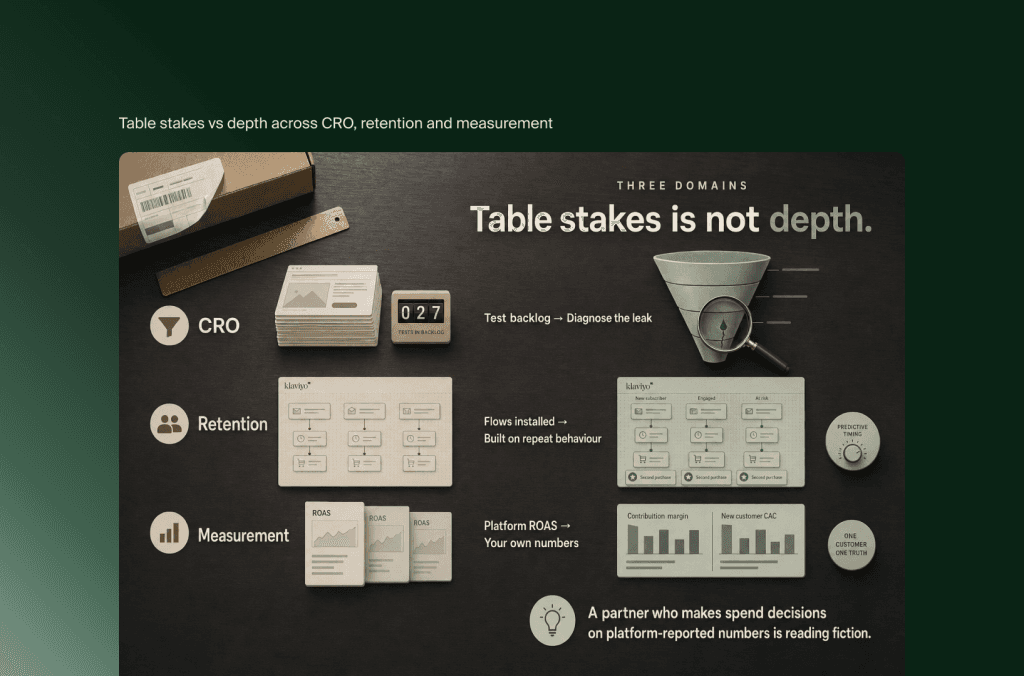
A real conversion partner finds where your funnel actually leaks, and whether the leak is a real store weakness or a traffic and measurement artefact, before proposing a single test. A weak one ships a backlog of best-practice tests and reports velocity, the number of experiments run, as if that were the outcome.
Ask them: walk me through how you would locate my biggest conversion leak before recommending tests. A weak answer sounds like: a standard list of tests and a promise of testing velocity, with no diagnosis first. The deeper version of this evaluation is worth its own read on how to judge a CRO partner.
4. Retention depth: they architect around economics, not just “set up Klaviyo”
Managing a Klaviyo account, building flows and sending campaigns, is table stakes. A retention partner adds the strategic layer: segmentation architecture, lifecycle design built around the second purchase, predictive timing, and reporting tied to lifetime value and unit economics. The difference is whether the flows connect to your actual repeat behaviour and margin, or are a generic install.
Ask them: how do you decide which retention flow to build first, and how do you time a replenishment for my product? A weak answer sounds like: a standard flow checklist with no reference to your customers’ real repeat cadence or your margins.
5. Margin literacy: they grow revenue without eroding it
A growth partner lifts average order value and revenue with levers that hold margin, thresholds set from your numbers, relevant cross-sells, value-adds, rather than reaching for the discount that gives margin straight back. A vendor’s default lever is a promotion, because it moves the top line fastest.
Ask them: how do you raise AOV or revenue without cutting into margin? A weak answer sounds like: discount-led tactics as the first and main answer.
6. Measurement honesty: their own numbers, not the platforms’
The CAC and ROAS your ad platforms report are inflated, because each platform claims the same customer. A partner who makes spend decisions on platform-reported numbers is reading fiction. A growth partner anchors on blended and new-customer CAC, contribution margin, and incrementality to assign credit honestly.
Ask them: whose numbers do you trust for a spend decision, the ad platforms’ or your own, and how do you separate the two? A weak answer sounds like: confident reliance on in-platform ROAS as the source of truth. This is the third gate.
7. They lead with diagnosis, not a fixed retainer or a promised number
A growth partner scopes from your unit economics and your constraint before proposing work, so the plan fits your brand rather than their template. Be especially wary of a percentage lift promised before anyone has seen your data, which is ambition dressed as a forecast.
Ask them: how do you decide what to work on first for my brand specifically? A weak answer sounds like: an identical retainer and playbook regardless of your situation, or a confident number attached to a store they have not yet been given access to.
The scorecard
Take this into your shortlist calls, ask every partner the same questions, and compare the answers rather than the pitches.
Criterion | Ask them | A weak answer sounds like |
1. Measures profit (gate) | How do you measure whether growth is profitable, and what’s in the report? | Blended ROAS and revenue; no contribution margin or new-customer CAC |
2. Whole system (gate) | If my constraint is conversion or retention, how does the work change? | Every answer is more spend or more creative |
3. CRO diagnosis | How would you find my biggest conversion leak before testing? | A test backlog and testing velocity, no diagnosis |
4. Retention architecture | Which flow first, and how do you time a replenishment? | A generic flow checklist, no link to repeat behaviour |
5. Margin literacy | How do you raise AOV without cutting margin? | Discounts as the default lever |
6. Own numbers (gate) | Platform-reported ROAS or your own numbers for spend decisions? | In-platform ROAS as the source of truth |
7. Diagnosis first | How do you decide what to work on first for me? | Same retainer for everyone; a % lift promised upfront |

How to score it
Three of the seven are pass-or-fail gates, not points to average: measuring profit (1), working the whole system (2), and measurement honesty (6). Those three are what separate a growth partner from a media-buying vendor, and a candidate who fails any of them is disqualified for profitable-growth work no matter how strong the rest of the scorecard or the case studies look. A vendor can be genuinely good at buying media and still fail all three, because buying media is not the same job as improving profitable growth.
The remaining four separate a strong growth partner from an adequate one, and are the way to choose between candidates who have already cleared the gates.
Where Flatline fits
We built this scorecard to be run against any partner, and that includes us. Here is what is verifiable about Flatline against it, stated as capability rather than claim.
Flatline is an official Shopify Plus and Klaviyo partner, with capability across the three domains this scorecard tests: conversion optimisation, retention and email built in Klaviyo, and the measurement and strategy layer that reads growth in unit-economics terms rather than platform ROAS. The practice is DTC-focused and diagnosis-led, which is the behaviour criteria 3 and 7 look for, and the reason the criteria are written the way they are is that they describe how this work is actually done well. We are not the only partner who can pass this scorecard, and you should make any candidate earn it, because the point of the criteria is to reward the real capability wherever you find it.
You will notice this section makes no promise of a specific lift, and that is deliberate: a number promised before we have seen your data is exactly the red flag criterion 7 names.
Start with a diagnosis
If you are ready to hire for profitable growth, the right first step is not a retainer and not a forecast, it is a diagnosis: a look at your unit economics and your funnel that names where your growth is actually constrained and whether it is profitable at the unit level. That gives you something concrete to evaluate any partner against, including us, and it is useful even if you go on to hire someone else. If you would like Flatline to run that diagnosis with you, across conversion, retention, and the measurement underneath both, get in touch and we will set it up, with no obligation to continue.
Key takeaways
The word “growth” sorts nobody. The real filter is what a partner is accountable for: profitable, durable growth, or channel performance.
Seven criteria span the three domains that matter, CRO, retention, and measurement. Three are pass-or-fail gates: measuring profit, working the whole system, and using their own numbers rather than platform-reported ones.
Ask every candidate the same questions and compare the answers, not the pitches. Weak answers have consistent tells, like resolving every problem to more spend, or reporting testing velocity as an outcome.
A media-buying vendor can be excellent at its job and still fail the gates, because buying media is a different job from improving profitable growth.
Be wary of a percentage lift promised before a partner has seen your data. Start with a diagnosis, not a forecast.
FAQ
What’s the difference between a DTC growth partner and a media-buying agency?
A media-buying agency is accountable for channel performance, clicks and reported ROAS on the campaigns it runs. A growth partner is accountable for profitable, durable growth across the whole system, conversion, retention, and the measurement underneath both, and reports in unit-economics terms like contribution margin and new-customer CAC. A vendor can be excellent at buying media and still not do the growth-partner job.
What should I ask a growth agency before hiring them?
Ask how they measure whether growth is profitable and what they put in the report, how the work changes if your constraint is conversion or retention rather than acquisition, how they locate a conversion leak before testing, and whether they trust platform-reported ROAS or their own numbers for spend decisions. The answers separate a growth partner from a channel-tactics vendor quickly.
Is a Klaviyo partner the same as a retention partner?
No. Managing a Klaviyo account, building flows and sending campaigns, is the baseline. A retention partner adds the strategic layer: segmentation architecture, lifecycle design around the second purchase, predictive timing, and reporting tied to lifetime value and unit economics. Confirm the partner does the strategy, not only the platform administration.
Related articles


