Raising AOV Without Discounting: Thresholds, Bundles and Cross-Sell That Hold Margin

By Robin Laseur

You can raise average order value without touching price, but the two easiest ways to try backfire. A blanket discount lifts cart size and gives the margin straight back. An aggressive free-shipping threshold pushes some carts higher and quietly taxes every customer who only ever wanted one thing. The margin-safe version is narrower and more deliberate: a threshold set just above where your carts actually cluster, a cross-sell that genuinely pairs with what is in the basket, and value-adds offered in place of price cuts. This guide gives you the method to set each from your own numbers, so AOV rises while completion rate and margin hold.
Start from your situation, not the tactic
The reason generic AOV advice underperforms is that it hands you tactics before it asks what you are working with. The situation that makes this hard is specific: a flat average order value, a margin thin enough that giving any of it away hurts, and a customer base that is a mix of people buying several items and people buying exactly one. Any lever you pull has to lift the first group without punishing the second, and without spending the margin you are trying to grow.
That rules out the two reflex moves. A blanket discount does raise cart size, but it lowers the margin on every unit including the ones the customer would have bought anyway, so a bigger order can easily be a less profitable one. An aggressively high free-shipping threshold nudges the near-threshold buyer to add an item, but it also tells the single-item buyer that their small order is being penalised, which shows up as abandoned carts rather than larger ones. The pathways below are built to avoid both failures.
Pathway 1: the threshold, set from your numbers
The free-shipping threshold is the highest-leverage AOV lever and the easiest to set badly. Setting it well is a method, not a guess.
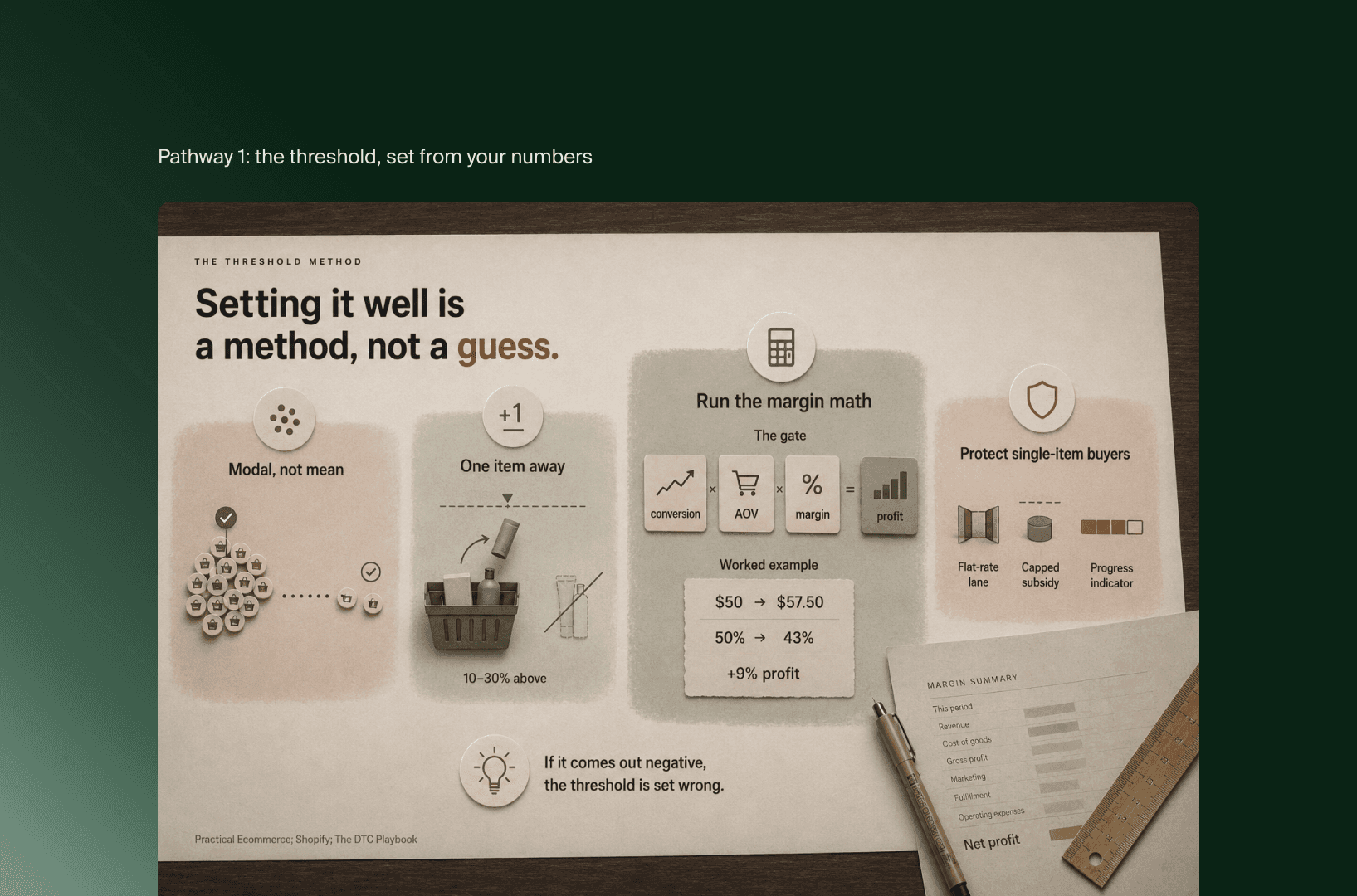
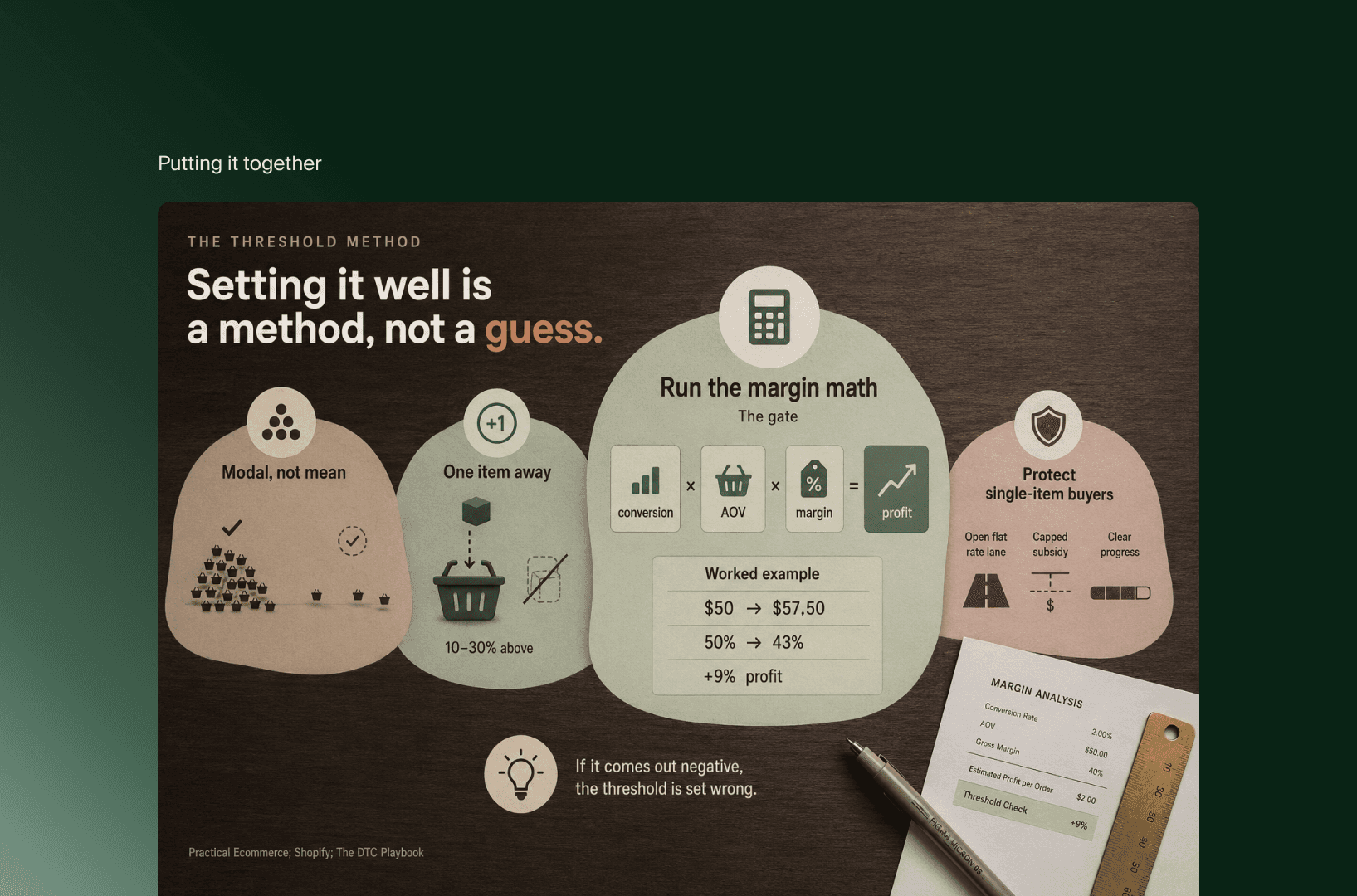
Base it on your distribution, not your average. The common instruction is to set the threshold above your AOV, but the mean is a misleading anchor because a few large orders pull it away from where most carts actually sit. Shopify’s own guidance, citing consultant Aaron Zakowski, is to work from your modal order value, the most common order size, and to keep the threshold attainable for the largest number of customers, because setting it too high risks abandoned carts rather than bigger baskets. Find where your carts cluster, and set the threshold a reachable step above that cluster.
Make it one item away, not two. The threshold should require adding a single reasonably-priced item to clear, not a second shopping trip. Published heuristics put the step somewhere between 10 and 30 percent above your typical order, and the right end of that range depends on your price points: a store with a $40 typical order and $15 add-ons has different reachable maths than one with $200 orders. Treat the percentage as a starting range to test, not a rule.
Run the margin math before you commit. A threshold only helps if the extra order value outweighs the margin you give up subsidising shipping, and that is a calculation, not a hope. It turns on three numbers moving together: the change in conversion rate, the change in AOV, and the change in gross margin once you absorb the shipping cost. Practical Ecommerce lays out the profit check as a single expression, the conversion multiplier times the AOV multiplier times one-plus-the-margin-change, minus one. In their worked example a threshold that moves conversion up slightly, lifts AOV from $50 to about $57.50, and drops gross margin from 50 to 43 percent still nets a profit increase of roughly nine percent, because the AOV gain outweighs the margin given up. Those are illustrative numbers, not a promise about your store. The point is the method: plug your own three figures in, and let the sign of the result tell you whether the threshold earns its keep. If it comes out negative, the threshold is set wrong or the subsidy is too generous.
Protect the single-item buyer. The threshold should nudge, never gate. Keep a cheap flat-rate option for the customer who genuinely wants one item, cap the subsidy so a large order does not hand back more shipping than it earns, for example “up to a set amount off shipping” rather than unlimited, and show a progress indicator so the buyer who is close can see the last few dollars to free shipping. The DTC Playbook’s threshold calculator, which sets the number from your own AOV, margin, and shipping cost, is a clean way to pressure-test the figure against your unit economics before it goes live. The goal is a threshold that the multi-item buyer clears happily and the single-item buyer never feels punished by.
Pathway 2: the paired cross-sell that adds at full price
The second pathway adds revenue with no discount at all, when it is done as a genuine pairing rather than a generic recommendation. A cross-sell earns its place when the suggested item actually completes what is already in the cart: the strap for the case, the refill for the device, the primer for the foundation. Relevance is what converts, and irrelevant “you may also like” grids mostly add clutter.
Two disciplines keep it working. Place it where the decision is live, in the cart or the slide-out drawer as the customer reviews the order, rather than buried on a product page they have already left. And keep the choice small, two or three relevant add-ons rather than a wall of options, because a short, obviously-related list reads as helpful while a long one reads as noise. Because the cross-sell is sold at full price, every attach is straight AOV with the margin intact, which is exactly what discount-based tactics cannot offer.
Pathway 3: value-adds instead of price cuts
The third pathway covers the cases where you want to reward a bigger order without discounting it, and the principle running through all of them is the same: add perceived value rather than subtract price.
A gift with purchase at a spend threshold, ideally a branded, genuinely low-cost item, creates a reason to reach the threshold while costing you a fixed, known amount rather than a percentage of every order, which protects margin far better than a blanket discount does. A curated bundle can be sold as a convenience and curation premium, the complete set assembled for the customer, rather than as a markdown, so the value is in the assembly, not the price. Where a bundle does need a discount to move, the margin-safe structure is to discount only the lowest-priced item in it and cap that discount, so the bundle looks generous without giving away the anchor product. And a premium-variant or larger-size upsell raises order value by moving the customer up the range rather than adding a discounted extra. Each of these lifts the order while keeping the price integrity that a discount surrenders.
Putting it together without eroding margin
The three pathways are not a menu to run all at once, they are matched to where your AOV is stuck. If most orders are single-item, the threshold and the paired cross-sell do the most work, because both are aimed at getting a second item into the cart. If orders already contain multiple items but sit at a low value, the premium-variant upsell and curated bundles move the basket up the range. Across all of them, the single-item buyer stays protected, because none of the pathways gate the checkout or penalise a small order, they only make a larger one more attractive.
The discipline that ties it together is measuring the right outcome. A higher average order value that comes with lower total profit is not a win, it is a more expensive way to run the same business, so judge every one of these changes on the profit-change math rather than on the AOV line alone. Setting these levers against your real margin, so they lift order value without quietly costing you more than they add, is the kind of merchandising work Flatline does with DTC brands. The starting move costs nothing: find your modal order value, and set one threshold a reachable step above it.
Key takeaways
You can raise AOV without discounting, but blanket discounts hand back margin and aggressive thresholds punish single-item buyers. The margin-safe levers are a well-set threshold, a relevant cross-sell, and value-adds over price cuts.
Set the free-shipping threshold from your modal order value, where carts actually cluster, not your mean AOV, and keep it one reachable item away rather than two.
Confirm the threshold with margin math, not hope: the change in conversion, AOV, and gross margin together decide whether it adds profit. A worked check like Practical Ecommerce’s profit formula tells you the sign before you launch.
Cross-sells add revenue at full price when they genuinely pair with the cart and are kept to a short, relevant list in the cart or drawer.
Prefer fixed-value gifts, curation-premium bundles, capped-discount smart bundles, and premium-variant upsells over percentage discounts, and always judge the result on profit, not on the AOV number alone.
FAQ
How do I set a free-shipping threshold that increases AOV without losing sales?
Base it on your modal order value, the most common cart size, rather than your average, and set it a single reachable item above that so a buyer clears it by adding one thing, not two. Then run the margin math, the combined change in conversion, AOV, and gross margin, to confirm it nets more profit, and keep a cheap flat-rate option and a progress indicator so single-item buyers are nudged rather than penalised.
How can I raise average order value without discounting?
Use levers that add value instead of cutting price: a well-set free-shipping threshold, relevant paired cross-sells sold at full price, fixed-value gifts with purchase at a spend threshold, curated bundles priced as a convenience premium, and premium-variant upsells. Each lifts the order while keeping margin intact, unlike a blanket discount that gives margin back on every unit.
Do bundles hurt margin?
Only if they are built as markdowns. A curated bundle sold as a complete set at full price adds order value with no margin cost. If a bundle needs an incentive to move, discount only the lowest-priced item in it and cap that discount, so the bundle feels generous without giving away the anchor product’s margin.
Related articles


F.A.Q.

How do I set a free-shipping threshold that increases AOV without losing sales?
Base it on your modal order value, the most common cart size, rather than your average, and set it a single reachable item above that so a buyer clears it by adding one thing, not two. Then run the margin math, the combined change in conversion, AOV, and gross margin, to confirm it nets more profit, and keep a cheap flat-rate option and a progress indicator so single-item buyers are nudged rather than penalised.
How can I raise average order value without discounting?
Use levers that add value instead of cutting price: a well-set free-shipping threshold, relevant paired cross-sells sold at full price, fixed-value gifts with purchase at a spend threshold, curated bundles priced as a convenience premium, and premium-variant upsells. Each lifts the order while keeping margin intact, unlike a blanket discount that gives margin back on every unit.
Do bundles hurt margin?
Only if they are built as markdowns. A curated bundle sold as a complete set at full price adds order value with no margin cost. If a bundle needs an incentive to move, discount only the lowest-priced item in it and cap that discount, so the bundle feels generous without giving away the anchor product’s margin.