



What a Shopify build covers
We start with how your customers buy and how your team works. From there we design the store and a design system, build the theme with sections your team can rearrange without a developer, choose apps where they fit and build custom where they do not, connect your systems, load products and content, set up tracking and consent, and test real orders before launch. After go-live we stay to monitor, fix and keep improving.
PROVEN
RESULTS
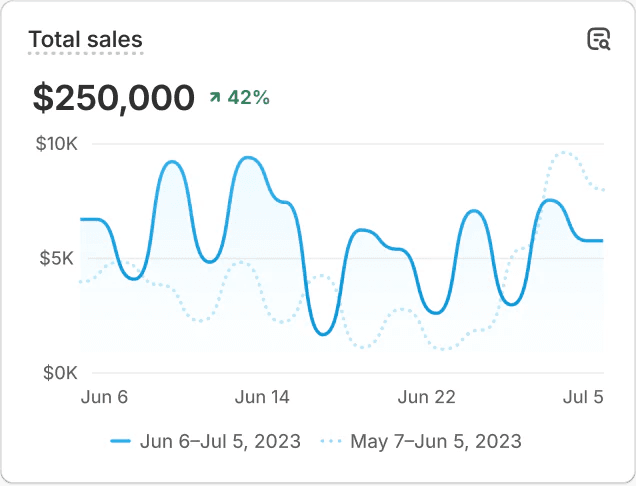
TOTAL SALES VS. PREVIOUS PERIOD



Shopify or Shopify Plus
Shopify is enough for many brands. Shopify Plus becomes worth it when the business asks for more than one store can carry:
B2B on the same platform, with company accounts, price lists and payment terms.
Several expansion stores for countries, brands or wholesale.
Checkout customisation and custom logic with Shopify Functions.
Automation with Shopify Flow and scheduled launches for drops and sales.
High order volumes and traffic peaks.
Speed comes with the platform: in the HTTP Archive Web Almanac 2025, 76% of Shopify sites passed all Core Web Vitals on mobile, against 35% of WooCommerce and Magento sites.
We advise the plan that fits your next years, not the biggest one. More on Shopify Plus.
What a build includes
Discovery: goals, customers, range, markets, systems and requirements.
UX/UI design and a design system, built around the decisions customers really make.
Theme development with sections your team can fill and rearrange without a developer.
Apps where they fit, custom functionality where they do not, and as few apps as possible.
Integrations with ERP, PIM, WMS, POS and marketing tools.
Product data, content and, where needed, migration from your current platform.
Tracking, consent and product feeds, tested before launch.
QA on devices and on real processes: checkout, discounts, returns and fulfilment.
Launch, training for your team and aftercare.
Design is often the first question. See Shopify store design and Shopify integrations.
What a Shopify store costs
A Shopify build is not priced per page. The budget follows from a handful of drivers:
An adapted theme or a fully custom design.
The number of templates and custom sections.
Product data, content production and any migration of existing data.
Integrations with your systems.
Markets, languages and B2B.
Apps versus custom functionality.
On top come running costs. These are Shopify’s Dutch list prices (October 2026), per month: Basic €21 (yearly) or €28 (monthly), Grow €59 or €78, Advanced €289 or €384, and Shopify Plus from €2,100 on a three-year term. With Shopify Payments, iDEAL costs €0.29 per transaction (€0.15 on Plus) and cards 1.9% to 1.4% plus €0.25. With an external payment provider such as Mollie, Shopify adds 2%, 1%, 0.6% or 0.2% per order, depending on the plan. All costs are listed in Shopify costs. After a short discovery you get a scope and budget you can defend internally.
Approach and timeline
We work in fixed phases, so you know at every point what has been decided and what is still open. A store on an adapted theme takes weeks rather than months; a custom design with integrations, markets or B2B takes longer.
Discovery and scope.
Design, from key templates to the full design system.
Development and integrations, delivered in reviewable parts.
Content and product data.
QA and acceptance with your team.
Launch, monitoring and the roadmap for after go-live.
For reference: John Beerens went live with more than 20,000 SKUs, B2C and B2B in one Shopify store, in six to eight months. Stoov merged four stores into one Shopify Plus store with Markets and saw 13% higher conversion and 50% faster pages.
Plan backwards from your peak. To sell on Shopify on Black Friday 2027 (26 November), we count six weeks for the scan, four for scope, about twenty for build, migration and testing, and six for launch and hypercare, followed by a code freeze from early November. In practice: the decision has to be made in February 2027.
Shopify stores we build and grow




Planning a new Shopify store?
Tell us about your brand, range, markets and timing, and what the current store does not do well. We reply with a first view on scope and approach, and suggest a short call to walk through it.


