Best Shopify SEO strategies for 2026

By Robin Laseur

Shopify SEO has become harder to predict. Not because Shopify is bad for SEO, but because search itself has changed. AI Overviews now appear on roughly 48% of all Google searches, product-led SERPs push organic results further down the page, Reddit threads and aggregator sites claim positions that used to belong to brand content, and thin AI-generated blogs flood informational categories. The Shopify SEO playbook from 2022 was not designed for any of this.
The stores that are growing through organic search in 2026 are not winning on metadata and keyword density alone. They are winning on technical structure, content depth, topical authority, and the kind of first-hand expertise that AI systems cannot synthesize from other sources.
This guide covers all of it.
This article explains:
What changed in Shopify SEO heading into 2026
Which technical SEO issues still hold Shopify stores back
How AI Overviews and generative search affect eCommerce traffic
Which SEO priorities actually drive revenue instead of vanity traffic
How Shopify brands can build stronger topical authority in competitive categories
The gap between stores that grow through search and stores that plateau is rarely about effort. It is almost always about execution. This guide covers where that execution tends to break down.
Why Shopify SEO looks different in 2026
Most Shopify SEO advice still focuses on metadata and keywords. That is not wrong, but it is no longer enough. The bigger challenge now is differentiation and crawlable site structure, and both have become harder to achieve as the SERP environment has grown more complex.
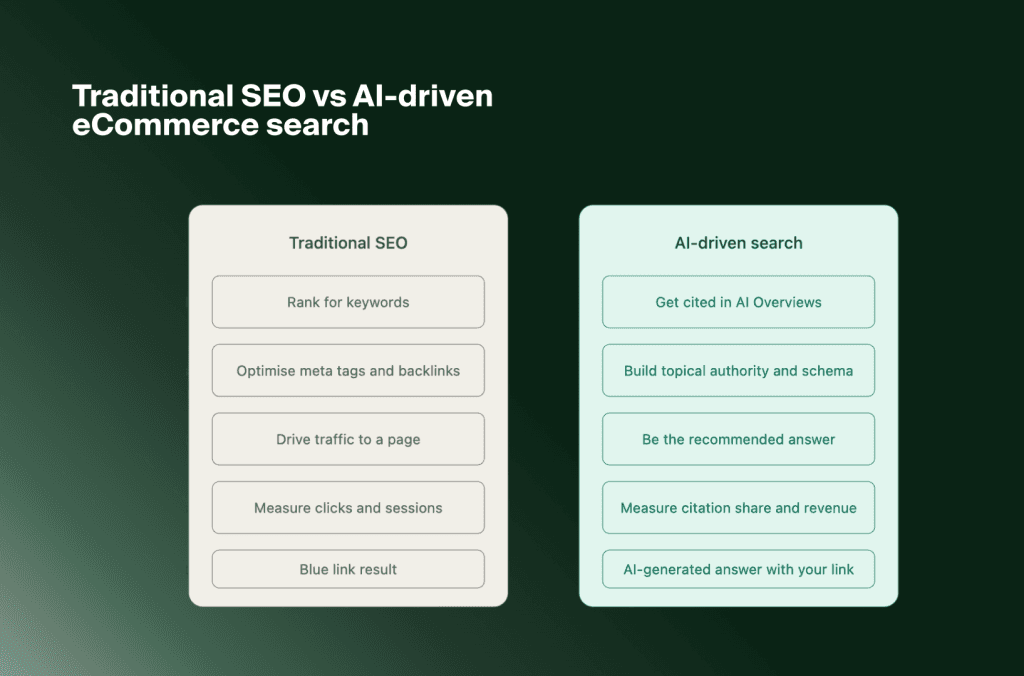
AI Overviews are compressing click-through rates on informational queries. A Seer Interactive study covering 5.47 million queries and 2.43 billion organic impressions found organic CTR on AI Overview-present queries dropped to 1.3% at its lowest point in late 2025, before recovering to 2.4% in early 2026. The recovery is real, but CTR levels have not returned to where they were before AI Overviews launched. For Shopify stores that rely on blog traffic to fill the top of the funnel, this is a structural shift, not a temporary dip.
Reddit and forum results are occupying SERP real estate. For comparison queries, product reviews, and brand research queries, Reddit threads and community forums now frequently rank on page one. These results push organic brand content down, especially for mid-funnel queries where Shopify stores used to convert well.
Thin AI-generated content is flooding eCommerce categories. The volume of AI-written product guides and category pages published in 2024 and 2025 means that being present in a category is no longer sufficient. Google’s quality signals increasingly reward content that reflects genuine operational experience, not content that paraphrases what already exists.
Authority matters more than it used to. E-E-A-T (Experience, Expertise, Authoritativeness, Trustworthiness) is not a new concept, but its weight has grown as Google tries to filter AI-generated noise from genuinely useful content. For eCommerce brands, this means product descriptions written by people who actually use the products, buying guides that address real customer questions, and content that reflects the brand’s actual expertise in its category.
Shopify SEO fundamentals that still matter
Technical fundamentals have not been replaced by AI strategy. They are the prerequisite for it. A store that is difficult to crawl, slow to load, or poorly structured will not perform in AI-influenced search any better than it performs in traditional rankings.
Site architecture
The way a Shopify store organizes its collections, products, and content directly affects how efficiently Google can crawl and understand the full catalogue.
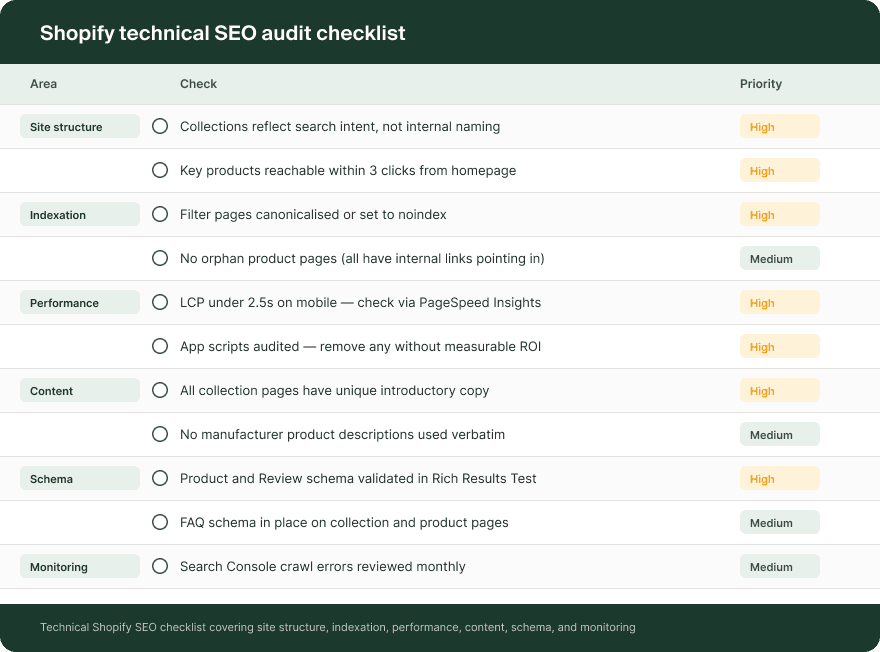
Collections should reflect search intent, not just internal logic. A collection named ‘Summer 2024 Drops’ makes sense internally but gives Google nothing useful. ‘Women’s linen summer dresses’ is crawlable and rankable.
Product hierarchy needs to be flat enough to crawl. Products buried more than three clicks from the homepage accumulate less page authority. Restructure collections so key products are accessible within two to three clicks.
Internal linking should be deliberate. Links between collection pages, product pages, and blog content pass authority and help Google understand topical relationships. Most Shopify stores underuse this.
Crawl depth compounds over time. Every new product or page added without internal links pointing to it becomes an orphan. Audit regularly.
Collection page optimization
Collection pages are the highest-leverage SEO asset on most Shopify stores. They rank for category-level queries with purchase intent, and they are consistently underdeveloped.
Unique introductory copy matters. A short, descriptive paragraph at the top of each collection page gives Google something to index that is not just product tiles. It does not need to be long. It needs to be useful and original.
Faceted navigation creates duplicate content risk. Filter combinations like colour, size, and price often generate unique URLs that are near-identical in content. Canonical tags and selective noindex directives are the standard fix.
Avoid splitting intent across collections. Two collections targeting overlapping queries will compete with each other. Consolidate where intent overlaps and use internal linking to support the primary collection.
Technical performance
Google’s Core Web Vitals remain a ranking signal and a proxy for user experience quality. The most common issues on Shopify stores are Largest Contentful Paint failures caused by unoptimized hero images, Cumulative Layout Shift from third-party scripts loading asynchronously, and slow Time to First Byte on stores running too many apps with front-end footprint.
App overload is the most common technical performance problem. Each installed Shopify app with a front-end script adds load time. Audit your app list quarterly and remove anything that cannot be justified by measurable revenue impact.
JavaScript rendering issues affect indexability. If product content is rendered client-side rather than server-side, Google may not index it reliably. Shopify’s default server-side rendering is an advantage here, but third-party customizations and headless implementations can introduce problems.
Image optimization is table stakes. Serve WebP or AVIF. Compress before upload. Lazy-load below-the-fold product images. None of this is new, but it remains consistently undone on stores that have scaled quickly.
Structured data
Schema markup is the bridge between your content and how search engines understand it. For Shopify stores, the priority types are Product, Review, FAQ, and Merchant Listings.
Product schema. Name, price, availability, and review aggregation. Most themes include basic schema; verify completeness, especially if you have customized the theme or use a headless setup.
Review schema. Star ratings in search results improve click-through rate. If your store collects reviews, the markup needs to be in place for Google to surface them.
FAQ schema. Particularly valuable on collection pages and product pages with common pre-purchase questions. Adds SERP real estate and improves the chance of appearing as a cited source in AI Overviews.
Merchant listings. Google’s Merchant Center integration enables free product listings in Shopping results. For Shopify stores, this is often set up once and then forgotten. Verify that your feed is clean and product data is current.
Flatline’s Shopify development services include structured data audits as part of technical SEO engagements.
Technical SEO mistakes Shopify stores still make
Most Shopify stores do not lose rankings because of one major issue. Rankings drop because small technical inefficiencies stack over time. None of the following are difficult to fix individually. The problem is that they accumulate undetected.
Indexing filter pages unintentionally
Collection filter combinations generate new URLs that Google can and will index if nothing prevents it. A store with fifty products and ten filter options can generate hundreds of near-duplicate pages. Use canonical tags to point filter variants back to the base collection URL, or use noindex for filter URLs that carry no standalone search value.
Duplicate collection structures
Stores that create seasonal collections, campaign-specific collections, or brand-filtered collections without canonical management end up with multiple pages targeting the same query. Google will pick one to rank. It may not be the one you want.
Overusing SEO apps
SEO apps can be useful for bulk meta tag editing and redirect management. They become a liability when stores use multiple overlapping tools, when app-generated schema conflicts with theme schema, or when apps inject scripts that slow down page load. One well-configured app is almost always better than three partially configured ones.
Slow third-party scripts
Live chat tools, review widgets, loyalty program scripts, and analytics platforms all add load time. Any script that is not critical to the purchase flow should be deferred or loaded asynchronously. Test load time before and after installing any new app.
Weak internal linking between collections
Collections on most Shopify stores exist in isolation. There are no links between complementary categories, no contextual links from blog content to relevant collections, and no breadcrumb trails that reinforce hierarchy. Internal links pass authority. Building them deliberately compounds over time.
Thin manufacturer product descriptions
Copying a manufacturer’s product description is one of the most common forms of duplicate content in eCommerce. Every competitor using the same supplier has the same description. Rewrite product copy around the customer’s actual questions: what problem does this solve, what makes it different, what do buyers need to know before purchasing.
Content strategy for Shopify SEO in 2026
Publishing blogs at a consistent cadence is not a content strategy. A content strategy for Shopify SEO means identifying the queries your target customers use at each stage of the purchase journey, then building content that earns rankings and supports conversion.
Build topical authority, not random blogs
Topical authority means Google recognizes your store as a comprehensive, reliable source on a specific subject. This is built by covering a topic cluster thoroughly, not by publishing a wide range of loosely related posts. A brand selling running shoes that has covered shoe fit, injury prevention, training for beginners, and race-day preparation builds topical authority in running. A brand that has covered running shoes once and also written about yoga and nutrition does not.
Create category-supporting content
The most direct content investment a Shopify store can make is content that supports its top-revenue collection pages. A buying guide that explains how to choose the right product, a comparison post between product types, or a care guide that answers post-purchase questions all feed internal link equity back to the collection while ranking for informational queries that precede purchase intent.
Transactional vs informational intent
Not all content serves the same purpose. Transactional content targets buyers who are ready to purchase: collection pages, product pages, comparison tables. Informational content targets buyers earlier in their journey. Both are necessary, but they require different approaches. Informational content that does not link back to products wastes its potential.
Why comparison content still works
Comparison queries continue to perform well in search because they carry high commercial intent. Shopify vs Magento, Shopify POS fees explained, platform migration costs: these are the queries Flatline targets through platform comparison content because the audience searching them is actively evaluating a decision. Cost-focused searches and operational queries, such as ‘how much does Shopify charge per transaction,’ represent buyers already in the consideration stage.
How AI-generated content is changing eCommerce SEO
Generic AI-written blogs are flooding eCommerce search results. The practical effect is that Google’s quality filters are being pushed to distinguish between content that looks authoritative and content that actually is. The differentiation increasingly comes from original insights, operational experience, and real implementation detail. A post that explains how a Shopify migration actually looks across twelve weeks, based on projects actually completed, will outperform a post that describes what a migration involves in abstract terms.
How AI Overviews affect Shopify SEO
As of early 2026, AI Overviews appear on approximately 48% of all searches, with informational queries triggering them at significantly higher rates than transactional ones. For eCommerce queries specifically, AIO presence is lower, around 4%, which means product pages and collection pages are less directly affected than blog content. The pressure falls disproportionately on informational content.
The data on citation matters. Seer Interactive’s research found that brands cited within AI Overviews consistently receive 2 to 5 times the organic CTR of brands that appear in organic results but are not cited. Being cited in an AI Overview is not an accident. It follows from having authoritative, well-structured content that answers specific questions clearly.
What this means for branded search. Brands with strong branded search volume are partially insulated from AI Overview traffic loss. When users already know the brand name and search for it directly, the SERP delivers brand content without AI interference. Investing in brand awareness through digital PR, content reach, and multi-channel presence protects organic traffic in a way that pure keyword optimization cannot.
Entity recognition is increasingly important. Google’s ability to understand what a brand is, what it sells, and what category it belongs to improves when that information appears consistently across the site, in structured data, in third-party mentions, and in the language used throughout product and content pages. Stores with a clear brand identity expressed in their content perform better in AI-influenced search than stores that present themselves differently across pages.
Brands that rely only on blog traffic may see diminishing returns unless SEO connects to stronger brand positioning and category authority. Rankings alone are a weaker KPI than they used to be.
Shopify SEO and GEO are starting to overlap
Generative Engine Optimization (GEO) is the practice of structuring content and technical data so that AI search systems, including Google AI Overviews, ChatGPT, and Perplexity, can understand, cite, and recommend a brand within their responses. Shopify’s own GEO guide describes how AI agents use ‘query fan-out’ to research a single prompt across multiple sub-queries, then synthesize results. If your store is visible in those sub-query results, citation in the AI response becomes more likely.
For most Shopify brands, GEO is not a separate discipline from SEO. It is what happens when SEO fundamentals are executed well. Clean structured data, clear product descriptions written in plain language, FAQ content that answers specific pre-purchase questions, and original content that cites specific details rather than generalities all contribute to GEO readiness without requiring a separate workflow.
Structured Q&A content performs well in generative search. FAQ sections on collection pages and product pages are not just for Featured Snippets. The conversational format maps directly to how AI search engines structure their responses. A question asked in natural language matched with a concise, factual answer in the page content is one of the clearest signals that a page contains citable information.
Semantic relevance matters more than keyword density. AI systems read pages the way an informed human would, looking for coherent coverage of a topic rather than the presence of a target phrase at a specific frequency. Writing that explains a topic thoroughly, in plain language, with specific details, performs better in generative search than writing that optimizes for keyword count.
Author credibility and first-hand experience are signals. Content attributed to authors with demonstrable expertise in a category, supported by real case detail and operational specifics, is more likely to be cited than generic brand content. This is the practical reason Flatline writes content from a partner perspective rather than as a general overview of what Shopify can do.
The overlap between SEO and GEO will deepen through 2026. The brands building for both now are the ones that will maintain search visibility as the SERP continues to evolve.
Shopify SEO tools worth using in 2026
The SEO tools market has not changed as dramatically as the search landscape. The fundamentals still apply: a crawler, a rank tracker, an analytics platform, and a search console integration. What has changed is how you interpret the data.
Google Search Console. Still the most important tool. The Page Experience report flags Core Web Vitals issues. The Search Results report shows which queries are driving impressions versus clicks, a gap that has widened as AI Overviews have grown. Free and non-negotiable.
Ahrefs or Screaming Frog. For technical crawl analysis: broken links, redirect chains, thin content pages, internal link distribution. Screaming Frog is best for deep crawls of the full store. Ahrefs adds competitor keyword data and backlink analysis.
Shopify Search and Discovery app. The native tool for managing synonyms, product boosts, and collection filtering within Shopify’s own search. Often overlooked but directly affects on-site search performance, which feeds conversion rate alongside organic rankings.
Schema validation tools. Google’s Rich Results Test for individual page validation. Schema.org documentation for reference. Run validation on product pages, collection pages, and blog posts after any theme update.
Session recording and heatmap tools. Hotjar or Microsoft Clarity show where users drop off, which CTAs they ignore, and where mobile layout breaks. SEO brings users to the page; UX determines what happens next. These tools connect the two.
Avoid building a tool stack around the premise that more tools produce better results. The insights from Google Search Console and one crawler will identify the issues that matter most on any Shopify store. Additional tools add value only when the fundamentals are already clean.
What a realistic Shopify SEO roadmap looks like
SEO timelines are almost always underestimated. A realistic roadmap for a Shopify store starting from a weak or inconsistent SEO baseline runs four months minimum before organic traffic changes become measurable. The work divides into three phases.
Phase | Focus areas |
Month 1 | Technical cleanup, indexing audit, Core Web Vitals review, metadata improvements across key pages |
Month 2 to 3 | Collection page optimization, content clustering around primary categories, internal linking structure |
Month 4 onward | Authority building through digital PR, comparison content, CRO and SEO alignment, GEO preparation |
The sequencing matters. Technical cleanup before content work ensures that new content is indexable and attributing authority correctly from day one. Content clustering before authority building ensures there is enough topical depth for backlinks to strengthen rather than arriving at isolated pages.
CRO and SEO alignment in the later phase is not optional. A page that ranks but does not convert does not produce revenue. Traffic quality is a more useful KPI than traffic volume, and it requires the SEO and conversion work to be considered together.
When Shopify SEO becomes a development problem
Most Shopify SEO can be managed without development resources. Metadata, content, internal linking, and structured data are all accessible through the Shopify admin or a Shopify Partner agency. There are specific situations where SEO requires developer involvement, and recognizing them early saves significant time.
Headless storefronts and JavaScript rendering
Headless Shopify implementations that render content client-side are systematically harder to crawl than server-rendered stores. If Google cannot see product content without executing JavaScript, it may not index it reliably. This requires developer-level fixes: server-side rendering, prerendering, or dynamic rendering for bot traffic.
Faceted navigation at scale
Stores with complex filtering systems, particularly those with many attribute combinations, need developer support to implement canonical tags, noindex directives, and URL parameter handling correctly. This is a technical SEO problem, not a content problem.
Multi-market and international SEO
Shopify Markets simplifies international storefront management, but hreflang implementation, URL structure decisions across markets, and content localization still require careful technical planning. Duplicate content across market-specific versions of the same page is a common and avoidable problem.
Custom filtering and collection logic
Stores that have built custom collection filtering outside Shopify’s native functionality often have crawl and indexation problems specific to their implementation. These require a technical audit before any content-level SEO work is applied.
Flatline builds and optimizes Shopify Plus storefronts across standard, headless, and multi-market configurations. The technical SEO layer is built into the development process rather than applied after the fact.
Final thoughts on Shopify SEO in 2026
Rankings are still a useful signal, but they are no longer the KPI that matters most. A store can rank on page one for a set of target keywords and still see organic revenue decline if AI Overviews absorb the clicks, if the landing pages do not convert, or if the queries being ranked are informational rather than transactional.
The stores gaining organic ground in 2026 are treating SEO as infrastructure rather than a campaign. Technical health, content depth, brand authority, and structured data work in combination. No single element produces results in isolation. The compounding effect of doing all four consistently is what separates stores that grow through search from those that plateau.
SEO is no longer isolated from UX, development, CRO, and brand authority. The more integrated those disciplines are in a Shopify brand’s operation, the better the SEO outcomes tend to be.
Flatline is a certified Shopify Platinum Partner with experience across technical SEO audits, eCommerce content strategy, and international storefront builds. That range of work sits under our broader ecommerce agency practice, so SEO recommendations account for the platform and storefront constraints behind them. If you want an honest assessment of where your store’s SEO stands, and where the highest-leverage fixes are, get in touch.
Related articles


